

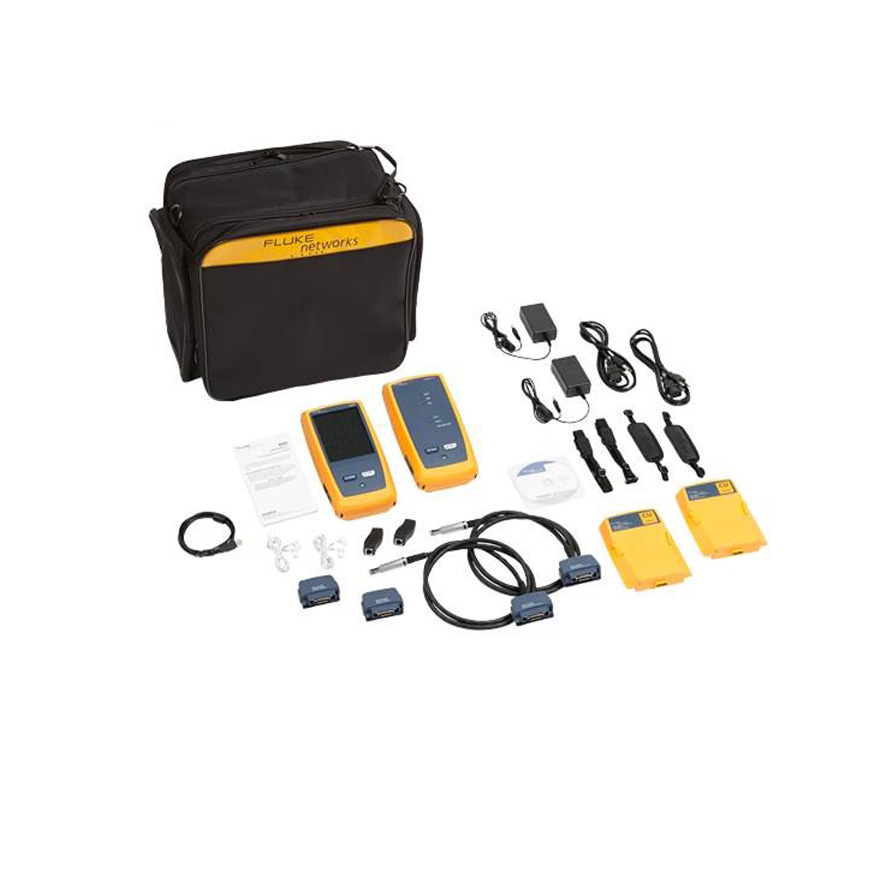
Selecting between the DSX-5000 and DSX-8000 cable testers requires understanding their performance capabilities and certification ranges. The DSX-5000 performs Cat 6A testing in 10 seconds, while the DSX-8000 completes the same test in only 8 seconds, establishing it as the fastest available tester in the current market.
Bandwidth Capabilities of DSX 5000 and DSX 8000
The bandwidth support represents a key distinction between these two models. The DSX-5000 certifies twisted pair cabling up to 1000 MHz frequency range, while the DSX-8000 extends this capability to 2000 MHz. The DSX-8000 has earned recognition as the first field tester independently certified for all Category 8 cabling requirements. Though the DSX-8000 requires a higher initial investment, the DSX-5000 delivers substantial value by potentially decreasing certification costs by up to two-thirds and contributing 10% to the bottom line on each job.
User Interface & Standards Compliance
Both testing units feature intuitive interfaces that provide clear “Pass” or “Fail” results according to TIA and ISO standards. The specific needs of your projects will determine which model provides better overall value for your testing requirements. This guide examines the essential factors to consider when choosing between these professional-grade Fluke cable analyzers.
CORE DIFFERENCES BETWEEN DSX-5000 AND DSX-8000
The primary differences between Fluke’s DSX-5000 and DSX-8000 cable analyzers are found in their technical specifications, certification capabilities, and testing performance.
Certification Range Comparison
The certification capabilities present a significant distinction in the DSX-5000 vs DSX-8000 comparison. The DSX-5000 certifies twisted pair Cat 5e, 6, 6A, and Class FA cabling. The DSX-8000 extends this range to include Category 8 and Class I/II cabling. This extended certification makes the DSX-8000 valuable for advanced network installations requiring higher-grade cable certification. The DSX-8000 is the first field tester independently certified to meet all Category 8 requirements, giving technicians an advantage when working with cutting-edge network infrastructure.
Bandwidth Support: 1 GHz vs 2 GHz
Bandwidth support marks another key difference between these models. The DSX-5000 functions with limits up to 1000 MHz (1 GHz), sufficient for most standard installations. The DSX-8000 doubles this capacity to 2000 MHz (2 GHz), making it compatible with higher-performance cabling systems needed for 25G and 40G applications. The DSX-5000 provides channel adapter and permanent link adapter functionality up to a 1 GHz range, while the DSX-8000 extends this capability to a full 2 GHz range.
Field Testing Performance
Both analyzers deliver excellent field testing performance, with a few notable differences:
- Testing Speed: The DSX-5000 completes Cat 6A tests in 10 seconds, while the DSX-8000 performs the same test in just 8 seconds. For Cat 8 testing, which only the DSX-8000 can perform, the completion time is approximately 16 seconds.
- Diagnostic Capabilities: Both models feature similar HDTDX/HDTDR diagnostic test times of approximately 3 seconds.
- Accuracy Standards: The DSX-8000 exceeds IEC Level VI and TIA Level 2G specifications, ensuring precise measurements essential for noise immunity in high-performance networks.
- Shield Integrity: Both testers feature shield integrity checking, with the DSX series being the first field testers to report exact distance to shield integrity issues, particularly crucial for data centers and Cat 8 installations.
CHOOSING THE RIGHT TESTER FOR YOUR PROJECT
Selecting the appropriate cable tester depends on specific project requirements. The DSX-5000 and DSX-8000 each excel in different testing environments.
Standard Commercial Building Applications: DSX-5000
The DSX-5000 provides optimal performance for standard commercial building infrastructure without unnecessary expense. This model certifies twisted pair Cat 5e, 6, 6A, and Class FA cabling with limits up to 1000 MHz, making it well-suited for typical office buildings, educational facilities, and retail spaces where 10 Gigabit Ethernet satisfies maximum requirements. The DSX-5000 advantages in these installations include:
- Cost efficiency with potential certification cost reduction of up to 66%
- Ten-second Cat 6A test time for faster certification in standard environments
- Capacity to store up to 12,000 test results with full graphics, supporting efficient management of large-scale building projects
Data Center and High-Performance Applications: DSX-8000
The DSX-8000 serves as the preferred choice for data centers and specialized high-performance environments. Its certification capability for cabling up to Cat 8 / 2 GHz makes it essential for facilities requiring 25G and 40G applications. The DSX-8000 becomes the necessary option when:
- Testing higher-performance cabling systems that demand precise measurements to ensure proper noise immunity for advanced applications
- Shield continuity testing is critical, particularly in data centers and Cat 8 installations
- TCL and ELTCTL balance measurements are required to determine noise immunity
Future Network Requirements
When evaluating DSX-5000 versus DSX-8000, future scalability becomes an important consideration. Proper cable infrastructure selection requires understanding long-term bandwidth requirements, transmission distances, and environmental conditions. As networks continue to evolve, selecting the appropriate tester is crucial since “selecting the right test limit when setting up for a test is arguably the single most important step”.
While the DSX-5000 meets current needs in most installations, the DSX-8000’s support for Cat 8 and 2000 MHz bandwidth provides substantial capacity for emerging technologies. Regular maintenance and upgrades remain essential regardless of which tester is selected. The final decision depends on balancing immediate project requirements against anticipated future needs to prevent costly retesting as standards evolve.
EASE OF USE AND SOFTWARE INTEGRATION
The operational efficiency of cable testing equipment depends on interface design and software capabilities. Both the DSX-5000 and DSX-8000 share critical operational features while providing distinct advantages during daily use.
Taptive User Interface
The DSX-5000 and DSX-8000 incorporate Fluke’s capacitive Taptive user interface, making complex testing procedures accessible to technicians regardless of skill level. This intuitive system reduces setup errors through simplified configuration. All jobs appear on a single menu screen, with job selection immediately confirming required tests. The interface features animated instructions guiding users through proper setup procedures, ensuring accurate testing results.
LinkWare Live Cloud Service
Both models integrate fully with LinkWare Live cloud service, allowing project managers to configure testers remotely, monitor testing progress, and locate testers in the field. Technicians can upload results directly from job sites via Wi-Fi connection, eliminating return trips to the office. The LinkWare Live system provides:
- Complete monitoring of all tests across multiple projects from any smart device
- Immediate notification of incorrect test settings
- Remote definition of cable IDs and test parameters for field testers
- Automatic firmware and standards updates
ProjX Management System
The ProjX system enhances workflow efficiency for both testers. This feature provides real-time status updates using a 0-100% completion scale for each job. The system creates automatic “Fix Later” punch lists for addressing workmanship issues. ProjX eliminates redundant data entry by saving job-specific details under simple project names, streamlining the process when switching between jobs or using multiple testers. The system manages test requirements from initial setup through system acceptance, ensuring correct test completion on the first attempt. These shared software capabilities significantly improve workflow regardless of which model is selected, allowing technicians to focus on certification tasks rather than equipment configuration.
COST AND RETURN ON INVESTMENT ANALYSIS
The financial aspects often serve as the determining factor when deciding between the DSX-5000 and DSX-8000. Understanding available rental options, immediate cost impacts, and long-term return on investment helps align equipment choices with business objectives.
Rental Options
Multiple rental opportunities exist for both the DSX-5000 and DSX-8000 through authorized Fluke partners. Service providers including Advanced Test Equipment Rentals, JM Test Systems, Electro Rent, and TRS-RenTelco offer customized rental arrangements based on specific testing needs. These rental arrangements provide several benefits:
- Same-day shipping with flexible rental durations
- Technical support from the rental provider
- Elimination of calibration and maintenance costs
- Options for renting, leasing, or eventual purchase
Short-Term Project Economics
For occasional testing requirements, renting delivers considerable savings compared to purchasing. Testing labor typically accounts for roughly 5% of cable installation costs, making rentals a sensible option for contractors with periodic certification needs. Professionals who perform limited testing can avoid capital expenses entirely by renting equipment or employing third-party certification services. Renting removes concerns about equipment becoming outdated while providing access to current technology. This approach proves especially beneficial for projects requiring specialized testing without ongoing equipment needs.
Long-Term Value Assessment
Ownership presents significant advantages for frequent testers. The Versiv platform (encompassing both the DSX-5000 and DSX-8000) can lower overall certification costs by up to two-thirds, potentially adding 10% to the bottom line on each job. Justifying the investment typically relates to certification efficiency. If projects require testing both Cat 6A and Cat 8, the DSX-8000 becomes the logical choice despite higher initial costs. Time savings directly impact profitability-faster certification processes result in more profitable operations. Certification testers represent long-term investments that amortize over hundreds of thousands or even millions of cable tests, making ownership practical for high-volume operations.
DSX-5000 vs DSX-8000 Comparison
| Feature | DSX-5000 | DSX-8000 |
| Cat 6A Test Speed | 10 seconds | 8 seconds |
| Bandwidth Support | 1000 MHz (1 GHz) | 2000 MHz (2 GHz) |
| Category Certification | Cat 5e, 6, 6A, Class FA | Cat 5e, 6, 6A, Class FA, Cat 8, Class I/II |
| HDTDX/HDTDR Diagnostic Test Time | ~3 seconds | ~3 seconds |
| Shield Integrity Testing | Yes | Yes |
| Maximum Test Results Storage | 12,000 with full graphics | Not mentioned |
| Cat 8 Testing Capability | No | Yes (16 seconds test time) |
| Accuracy Standards | Not mentioned | Exceeds IEC Level VI and TIA Level 2G |
| Interface Type | Taptive touchscreen | Taptive touchscreen |
| LinkWare Live Integration | Yes | Yes |
| ProjX Management System | Yes | Yes |
| Best Suited For | Common building cabling, standard commercial installations | High-speed data centers, 25G/40G applications |
| Cost Efficiency | Can reduce certification costs by up to 66% | Higher price point than DSX-5000 |
The selection between DSX-5000 and DSX-8000 depends on specific testing requirements and needs. Both Fluke testers provide excellent performance with their Taptive interfaces and LinkWare Live integration capabilities. Several key distinctions should guide this decision.
The DSX-5000 performs exceptionally well in standard commercial settings where Cat 6A certification represents the highest requirement. With 10-second test times and frequency support up to 1000 MHz, this model effectively balances performance and cost considerations. Contractors primarily working in office buildings, educational facilities, and retail locations will find the DSX-5000 suitable while potentially reducing certification expenses by up to 66%.
The DSX-8000 proves more valuable for data center environments and advanced network installations. Its 2000 MHz bandwidth support, 8-second Cat 6A test completion time, and Category 8 certification capabilities make it essential for 25G and 40G applications. Despite higher initial cost, the DSX-8000 offers necessary capabilities for evolving network standards. Rental options for both testers provide flexibility for temporary or specialized testing needs, while ownership delivers greater value for high-volume operations.
A thorough assessment of project requirements, technical specifications, and budget constraints should precede the final decision. The DSX-5000 remains highly effective for mainstream applications, while the DSX-8000 represents advanced field testing technology for those requiring sophisticated certification capabilities. The optimal choice aligns with both current project demands and future testing requirements.
FAQs
What are the main differences between the Fluke DSX-5000 and DSX-8000 cable testers?
The key differences lie in their certification capabilities and testing speeds. The DSX-5000 certifies up to Cat 6A at 1 GHz, while the DSX-8000 extends to Cat 8 at 2 GHz. The DSX-8000 is also slightly faster, completing a Cat 6A test in 8 seconds compared to the DSX-5000’s 10 seconds.
Which cable tester is better for standard commercial building installations?
For typical commercial building installations, the DSX-5000 is often the more suitable choice. It efficiently handles Cat 5e, 6, and 6A certifications, which are common in office environments, schools, and retail spaces. It offers cost-effective performance for most standard network infrastructures.
How do these cable testers integrate with cloud services?
Both the DSX-5000 and DSX-8000 integrate with LinkWare Live cloud service. This allows for remote configuration of testers, job progress tracking, and direct uploading of test results from job sites via Wi-Fi. It enhances workflow efficiency and project management capabilities.
Are there rental options available for these cable testers?
Yes, both the DSX-5000 and DSX-8000 are available for rent through Fluke’s authorized partners. Rental options provide flexibility for short-term projects or specialized testing needs without requiring a significant capital investment.
How do the DSX-5000 and DSX-8000 compare in terms of long-term value?
While the DSX-8000 has a higher upfront cost, it offers more advanced capabilities and future-proofing for evolving network standards. The DSX-5000 can potentially reduce certification costs by up to two-thirds for standard installations. The best long-term value depends on your specific testing requirements and the types of projects you typically handle.
