

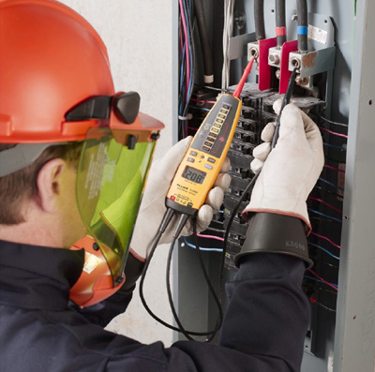
Understanding NFPA 70E – The Benchmark for Electrical Safety
Electrical hazards remain one of the most serious risks in industrial and commercial environments. The NFPA 70E Standard for Electrical Safety in the Workplace establishes the framework for protecting personnel from shock, electrocution, arc flash, and arc blast incidents.
While NFPA 70E is not federal law, it provides the accepted benchmark for demonstrating compliance with OSHA’s General Duty Clause (Section 5(a)(1)), which requires employers to maintain a workplace free from recognized hazards. Adopting the practices in NFPA 70E demonstrates a company’s commitment to safety and due diligence in protecting its workforce. When employees operate near or on energized equipment, NFPA 70E mandates that qualified personnel must:
- Conduct an Arc Flash Hazard Analysis
- Deliver qualified and general worker training
- Establish shock and flash protection boundaries
- Provide ANSI-rated PPE and protective clothing
- Label electrical equipment for shock and arc flash hazards
- Obtain authorization via a “Live Work” permit
Performing an Arc Flash Hazard Analysis
Arc flash analysis is the foundation of electrical safety planning. IEEE 1584-2018 (outlined in earlier editions as Section 4 of IEEE 1584-2002) defines the process for quantifying risk and determining protection requirements. The goal is to identify the flash protection boundary and calculate incident energy at expected working distances.
Nine Steps to Conduct an Arc Flash Analysis
- Collect System Data Create a one-line diagram showing all electrical components, including transformers, switchgear, protective devices, and interconnecting cable lengths and sizes.
- Consider All Modes of Operation Evaluate different operational configurations (normal, backup, maintenance, or generator mode) that may change available fault currents.
- Calculate Bolted Fault Currents Determine the maximum fault current possible at each point in the system. This value represents a worst-case short circuit.
- Calculate Arc Fault Currents Estimate the lower current that would actually flow during an arcing fault. (Typically, an arc fault current is 40-60 % of the bolted fault current.)
- Evaluate Protective Device Characteristics Determine how quickly breakers or fuses will react. Upgrading to current-limiting devices can significantly reduce incident energy.
- Document System Voltages and Bus Gaps Record nominal voltage and electrode spacing, as both influence arc behavior.
- Estimate Working Distances Measure the distance between workers and the potential arc source (face, torso, and hands).
- Calculate Incident Energy Use IEEE 1584 equations or approved software to compute the thermal energy released (cal/cm²) at each working distance.
- Establish the Flash Protection Boundary (FPB) Define the minimum safe approach distance beyond which a worker would receive no more than 1.2 cal/cm² of incident energy-the threshold for a second-degree burn.
Shock Hazard Analysis and Safe Approach Boundaries
Electrical shock risk exists even when arc flash potential is minimal. NFPA 70E defines three approach boundaries that limit personnel exposure to energized conductors based on voltage levels:
1. Limited Approach Boundary
The minimum distance an unqualified person may approach. Only a qualified worker wearing required PPE may cross this line, and an unqualified person may do so only under direct supervision.
2. Restricted Approach Boundary
Crossing this boundary requires a written plan, proper PPE, and training in shock-protection techniques. No worker may enter the prohibited area or contact live parts directly.
3. Prohibited Approach Boundary
This zone may only be entered when:
- A full risk assessment justifies energized work.
- The task is documented and authorized.
- The worker is qualified, trained, and properly equipped with PPE rated for direct contact.
Establishing these boundaries helps ensure that every worker in proximity to energized components follows procedures designed to prevent electric shock or electrocution.
The Arc Flash Protection Boundary
The Flash Protection Boundary (FPB) defines the minimum safe distance from energized equipment at which the incident energy equals 1.2 cal/cm² for 0.1 seconds-the threshold that causes a second-degree burn to exposed skin. If work must be performed within this boundary, personnel must wear arc-rated PPE and other protective gear suitable for the calculated incident energy. Key guidelines:
- For low-voltage (<600 V) systems with fault exposure below 100 kA-seconds, a conditional FPB of 48 inches is typically used.
- The FPB always takes precedence over shock boundaries. If the FPB exceeds the Limited Approach Boundary, no unqualified person may enter without PPE.
IEEE 1584 and NFPA 70E provide formulas to calculate exact FPB distances for voltages ranging from 208 V to 15 kV.
Selecting the Right Arc-Rated PPE
NFPA 70E categorizes arc flash risk into Hazard/Risk Categories (HRC 0-4), each corresponding to increasing levels of incident energy exposure and PPE requirements.
| HRC | Incident Energy Range (cal/cm²) | Typical PPE |
| 0 | < 1.2 | Non-melting cotton; safety glasses |
| 1 | 1.2-4 | FR shirt/pants (4 cal/cm² rating) |
| 2 | 4-8 | FR clothing (8 cal/cm²), arc-rated face shield |
| 3 | 8-25 | FR suit, hood, gloves, hearing protection |
| 4 | 25-40 | Full arc-flash suit (≥40 cal/cm²) |
Best Practices for PPE Selection
- Choose FR clothing tested to ASTM F1506 and rated by Arc Thermal Performance Value (ATPV).
- Match the ATPV to the calculated incident energy at the worker’s position (typically 18-24 in from the arc source).
- Avoid over-specifying PPE; excessive layers can reduce dexterity and increase heat stress.
- Include additional protection: insulating gloves (ASTM D120), safety eyewear, hearing protection, and dielectric footwear.
Arc Flash Warning Labels
To maintain compliance, NFPA 70E requires field labeling of all equipment likely to require maintenance while energized, including:
- Switchboards and panelboards
- Industrial control panels and MCCs
- Meter socket enclosures
Labels must be clearly visible and include:
- Nominal system voltage
- Available fault current
- Arc flash boundary
- Incident energy or PPE category
Over-labeling can be as confusing as under-labeling. When multiple access points exist, always post data for the greatest hazard level.
The “Live Work” Permit
Before any energized work begins, NFPA 70E mandates a Live Work Permit approved by management. The permit must:
- Explain why the task cannot be de-energized.
- Define shock and arc flash boundaries.
- Specify required PPE and protective equipment.
- Be signed by a responsible authority.
No work on energized equipment should occur without a formal risk assessment, written authorization, and full compliance with NFPA 70E procedures.
Conclusion: Building a Culture of Electrical Safety
Meeting NFPA 70E compliance requirements is more than a regulatory exercise-it’s a critical investment in the well-being of workers and the reliability of operations. By performing comprehensive arc flash and shock hazard analyses, establishing protection boundaries, and equipping personnel with the right PPE, organizations can drastically reduce the risk of injury or fatality.
At JM Test Systems, we support compliance with NFPA 70E and IEEE 1584 through electrical safety equipment, PPE testing, and calibration services.
