


There are two types of clothing to which this discussion applies; one known as Flame Resistant (FR) and the other known as Arc Rated (AR). The difference is significant. All AR clothing (ARC) is FR rated, but not all FR clothing (FRC) is AR rated. The two types have different standards to which they must comply. ARC is not only flame resistant; it must also withstand the extremely high momentary temperatures generated by an arc flash incident. It must be rated according to the maximum intensity in calories per square centimeter (cal/cm2) it can withstand. Therefore, all ARC must have an Arc Thermal Performance Value (ATPV) rating for woven fabrics or an Energy Breakdown Threshold (EBT) rating for knit fabrics and shown on the label. Both of these are given in cal/cm2.[1] Since JM Test Systems deals with electrical safety, for simplicity, this article will only refer to arc resistant clothing, but this information applies equally to all thermal and flame resistant clothing as well.
Why should we be so particular about the care of this clothing and concerned about its life expectancy? Because we want to ensure that it will be able to withstand the arc flash intensity for which it is rated for the useful life of the garment. If it is improperly laundered, cared for or worn out, it may fail at a much lower energy level resulting in injury to the wearer. We offer thorough cleaning on any arc flash protection suit. A special detergent cleans each suit and other types of PPE cleaning is available. Our electrical safety testing lab completes each cleaning.
The big question has always been, “How long will ARC last?” There are a lot of answers. There is no “pat” answer. The user will always be referred to the manufacturer when asked that question, just like care and maintenance of the clothing, and the answer will vary from one to another.
One way to judge when your ARC is worn out is to keep track of how old it is. There are many different AR fabrics in use now and each has a different lifespan. For daily wear ARC, the general rule of thumb is to own 5 sets with each set being washed and worn at least once a year. Used according to these guidelines, treated 100% cotton (like Westex Indura®) lasts an average of 12 to 16 months, 88/12 cotton and nylon blends last for 18 to 30 months, and 93% Nomex® blends last anywhere from 2-1/2 to 4 years. As always, if in doubt, check the manufacturer’s instructions.[2
Number of washings is often used, but also is a poor way to judge lifespan simply because there are too many variables in soil level, contamination and laundering conditions, and no practical way to track number of washings. If there is some routine schedule set up, it is possible to use number of washings as an estimate, but this should include inspection of the clothing and material to determine its condition. Time estimates may still be the most practical since a date can be marked on the clothing and tracked.
ARC can be expensive to replace, so keeping it in service as long as possible — without significantly sacrificing protection — is a desirable goal. At some point during the life of any AR garment, it is necessary to consider removing it from service due to basic wear and tear. Although most recognized brands of AR fabric are made to maintain their flame resistance for the life of the garment, physical damage may also dictate the need to remove them from service. For most practical purposes, garments may be removed from service based on subjective evaluation if, after regular inspections, the garment is found incapable of effectively protecting the wearer. Ultimately, it is the end user’s responsibility to retire AR clothing.[4] This is the best guidance I have found. The final judgment call should be made based upon inspection of the garment the same as for the other protective equipment such as face shields, gloves and other AR rated items. Even though electrical gloves are periodically tested, regular inspection also is required. We should inspect our ARC prior to use the same as we do for our electrical gloves.
In trying to determine when it’s time to retire an AR garment from service, perhaps these tips and pictures will help. If any of these wear indicators appear, stop wearing the garment to minimize possibility of injury. First and foremost, be sure to adhere to your company’s safety policy.
- Is torn, ripped, threadbare or frayed around the edges (see images below).
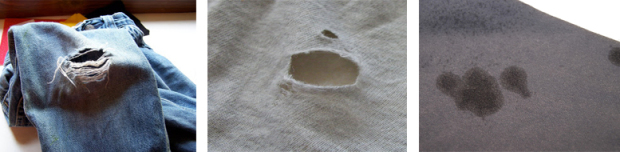
- Is stained with a flammable substance that cannot be removed through laundering (see image on right above). If exposed to flame or electric arc, flammable soil could ignite and continue to burn – even though the garment itself won’t burn.
- Has had contact with bleach.
- Has a frayed collar, frayed cuffs or torn, open or frayed seams (see images below).
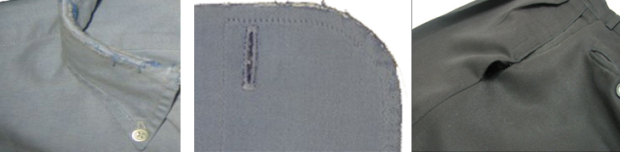
Obviously, if the garment is in otherwise good condition, some types of damage can be repaired. Our electrical safety lab provides repair on arc flash suits. After the cleaning, we perform minor sewing repairs. A seamstress repairs small tears or rips, replaces both broken zippers, and Velcro. Replacement face shields are also available for purchase if needed. JM technicians will replace the broken shield before visual and quality inspections.
Proper washing will ensure that this clothing lasts as long as it should and will protect the way it is meant to. Along with that, recognizing when AR clothing needs to be repaired or replaced is important for personal safety on the job.[5]
For standard guidance, please see ASTM F2757.
Sources cited:
[1] http://arcwear.com/blog/atpv-vs-ebt-explained-simply/
[2] http://www.cableorganizer.com/articles/how-to-take-care-of-arc-flash-clothing.html
[4] Mark Saner, Industrial and Hygiene News, October 2, 2014
[5] https://blog.tyndaleusa.com/2013/09/10/3-tips-on-how-to-wash-fr-clothing-and-its-useful-wear-life/ (also garment photos)
